
Light Requirements
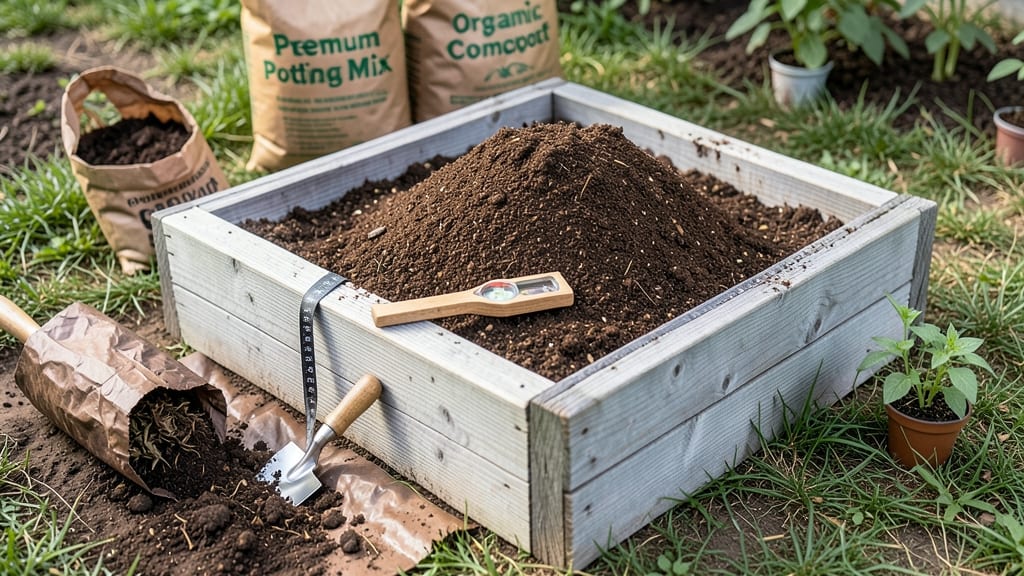
Filling a raised garden bed with the right amount of soil means knowing how much soil to fill it—because too little or too much can ruin your plants before they even sprout.
Picture this: you’ve spent hours building the perfect raised bed, only to realize halfway through filling it that you either need three more bags of soil or have wasted money on extras you’ll never use.
The key isn’t just guessing—it’s measuring your bed’s dimensions, accounting for root depth, and choosing the right soil mix to avoid costly mistakes.
Most gardeners assume 6 to 12 inches of soil is enough, but that depends on what you’re growing. Shallow-rooted herbs like basil thrive in just 6 inches, while deep-rooted veggies like tomatoes need a full foot or more.
Without the right depth, your plants won’t grow strong, and your hard work could go to waste.
In this guide, I’ll break down exactly how to calculate soil volume for your bed’s size, the best soil blends for different plants, and how to avoid overfilling or underfilling—so you can get it right the first time.
Ideal raised garden bed soil depth by plant type: root needs breakdown
When filling your raised garden bed, one size doesn’t fit all. The soil depth you choose directly impacts which plants thrive and which struggle. Shallow-rooted greens like lettuce need just 6 inches of loose soil, while deep-rooted asparagus or tomatoes demand 12+ inches to spread and access nutrients.
Getting this right means better yields, stronger plants, and fewer headaches down the road.
Most gardeners default to 12 inches of soil for versatility, but this isn’t always necessary—or even ideal. For example, radishes or spinach can rot if buried too deep, while carrots or beets need extra room to grow their edible roots.
Understanding these needs helps you customize your bed for maximum efficiency, whether you’re growing herbs, fruiting plants, or ornamental flowers.
Here’s the key: Soil depth affects drainage, aeration, and root stability. Too little soil restricts growth, while too much can lead to compaction or wasted space. The solution? Match your soil depth to the root systems of what you’re planting.
Below, we break down the ideal depths for common garden categories, so you can plan your raised bed like a pro.
For shallow-rooted greens, like lettuce or spinach, stick to 6–8 inches of soil. These plants thrive near the surface, where moisture and nutrients are abundant. Over-filling can lead to rot or stunted growth because their roots don’t need to penetrate deeply.
Instead, focus on keeping the soil light and fluffy, with plenty of organic matter to retain moisture without becoming waterlogged.
On the opposite end, deep-rooted perennials like asparagus or rhubarb demand 18–24 inches of soil to establish strong root systems. Without enough depth, these plants will struggle to anchor themselves, leading to poor yields or even death over time.
If your raised bed isn’t tall enough, consider layering soil or planting these varieties in dedicated deep beds.
For fruiting plants, such as tomatoes or peppers, aim for 12–18 inches of soil. These plants need room to develop extensive root networks, which support their heavy fruit production.
A deeper bed also improves drainage, reducing the risk of blossom end rot in tomatoes—a common issue caused by inconsistent moisture. Adding a compost layer at the bottom can further enhance nutrient availability for these hungry plants.
Don’t forget about herbs and leafy greens, which often get overlooked. While they don’t need as much depth as fruiting plants, they still benefit from 8–10 inches of well-aerated soil.
For example, basil and cilantro prefer a looser mix to prevent root rot, while kale and chard can tolerate slightly denser soil as long as it’s rich in nutrients. Mixing in vermiculite or perlite can help improve aeration for these plants.
If you’re growing a mix of plants in one bed, aim for a compromise depth of 12 inches. This gives you flexibility to plant both shallow and moderately deep-rooted varieties without sacrificing performance. For instance, you could tuck lettuce along the edges and plant carro
How to calculate soil volume for your raised bed: step-by-step formula
Calculating the exact amount of soil needed for your raised bed prevents waste and ensures your plants thrive. The key is measuring your bed’s usable volume, not just its outer dimensions.
Most gardeners overestimate soil needs by ignoring the frame thickness—a common mistake that leads to buying extra bags or leaving gaps.
Start by measuring your bed’s length, width, and height in feet. For example, a standard 4x8 ft raised bed with 10-inch-high walls won’t hold 32 cubic feet of soil—you’ll need to subtract the wood’s thickness. Let’s break it down step by step.
- 1 Measure your bed’s inner dimensions. Subtract 2x frame thickness from length/width (e.g., 4 ft bed with 6-inch-wide wood = 2.5 ft usable width).
- 2 Calculate soil depth. Most plants need 6–12 inches (0.5–1 ft). For deep-rooted veggies like tomatoes, aim for 12 inches.
-
3
Use the volume formula:
Length × Width × Depth = Cubic Feet. Example: 3.5 ft × 7.5 ft × 1 ft = 26.25 cu ft for a 4x8 bed with 10" soil. - 4 Adjust for soil type. Loam mixes settle 10–20% more than compost-heavy blends. Buy 10% extra to account for settling.
- 5 Convert to bags. A 2 cu ft bag covers 2 sq ft at 12". For 26.25 cu ft, you’ll need 13–14 bags (accounting for settling).
For a 3x6 ft bed with 8-inch walls, subtract 1 ft total width (0.5 ft per side) and use 0.67 ft depth (8 inches). Your calculation: 2 ft × 5 ft × 0.67 ft = 6.7 cu ft.
This translates to 4 bags of 2 cu ft soil if using a loam-compost mix.
Pro tip: Use a soil calculator (like those from University Extension offices) to double-check. They account for frame thickness and soil compaction automatically. Always test your soil’s drainage after filling—poke a hole with a stick; if water pools, add perlite or sand.
Remember, overfilling can cause root rot from poor drainage, while underfilling limits root growth. Aim for 6–12 inches of well-aerated mix, and your plants will reward you with bigger harvests all season. 🌱